For decades, Iran has structured its national security strategy around a single assumption: that a direct military confrontation with the United States is always possible.

Lacking the economic strength, air power, and naval dominance of Washington, Tehran has instead built an asymmetric war doctrine designed to raise the cost of conflict—not just for the US, but for the entire Middle East and global economy.
Now, with a US aircraft carrier strike group moving into the region and President Donald Trump openly warning of possible military action, concerns are mounting that tensions could spiral into a far wider war. While Iran has been weakened by Israeli and US strikes, internal unrest, and economic pressure, security analysts say the Islamic Republic retains enough firepower and leverage to respond in ways that would be deeply destabilising.
Whether Iran escalates aggressively or exercises restraint will depend on how severe it judges the threat to be.
“If Tehran believes the regime itself is at risk, it will not hold back,” said Farzin Nadimi, a senior fellow at the Washington Institute. “In a scenario they view as existential, they could deploy nearly all the tools they’ve spent decades developing.”
Missile and drone retaliation: Iran’s first line of response
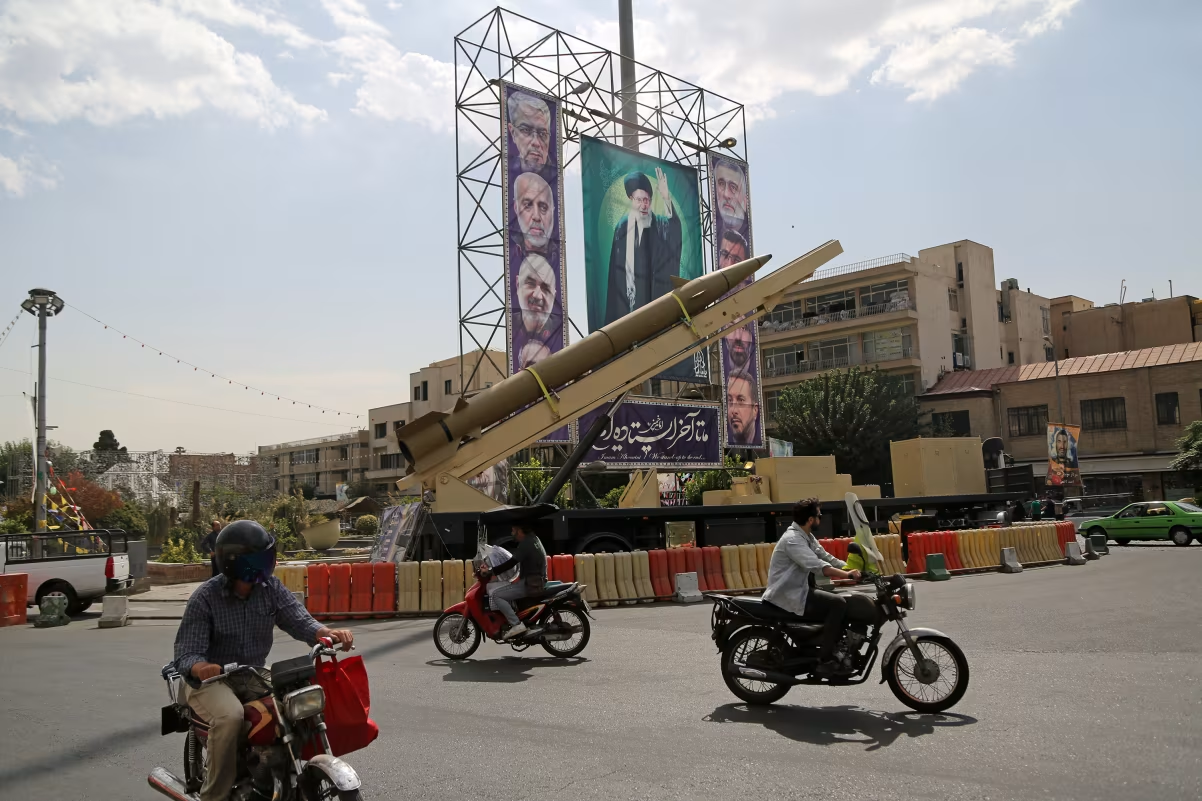
Iran’s most immediate option would be to strike back with missiles and drones, weapons it has stockpiled and refined for years.
The country is believed to possess thousands of ballistic missiles and one-way attack drones capable of reaching US military installations across Iraq, Syria, the Gulf states and beyond. Israel would almost certainly also be a primary target.
In previous confrontations, Iran has demonstrated its willingness to use these systems directly. Following Israeli strikes last year, Tehran launched large-scale missile and drone barrages that overwhelmed parts of Israel’s air defence network and caused measurable damage.
Although Israel and the US have since degraded Iran’s missile stockpiles and production facilities, intelligence estimates suggest Tehran still retains over a thousand operational missiles, with manufacturing efforts underway to replenish losses.
Iran’s drone programme, particularly the Shahed series, has become one of its most effective tools. These drones have been used extensively by Russia in Ukraine, proving both inexpensive and difficult to counter in large numbers.
US officials acknowledge the vulnerability of American forces in the region. Tens of thousands of US troops are stationed across multiple bases, many well within missile and drone range.
Even outdated Iranian aircraft and air defence systems, analysts say, complicate any attempt at a clean, decisive US strike.
Proxy warfare: activating Iran’s regional network
Beyond its own arsenal, Iran has long relied on regional allies and militias to project power while maintaining plausible deniability.
Although Israel has significantly weakened this network over the past two years—particularly Hezbollah in Lebanon—many of these groups remain operational and ideologically aligned with Tehran.
Iraqi militias such as Kataeb Hezbollah and Harakat al-Nujaba, both of which have previously attacked US troops, have openly declared their readiness to act if Iran is hit. Public statements from their leaders have called for coordinated action across the region.
The Houthis in Yemen remain among Iran’s most disruptive partners. Despite repeated US and Israeli strikes, the group has continued targeting shipping and has hinted at renewed escalation. Their past attacks on Red Sea trade routes demonstrated how a relatively limited force can generate global consequences.
Still, Iran’s proxies face constraints. Hezbollah’s military capacity has been reduced, Iraqi militias face pressure from Baghdad, and regional governments are increasingly wary of being dragged into another large-scale war.
Even so, analysts warn that proxy attacks would likely be among Tehran’s earliest moves, allowing Iran to strike US and Israeli interests without immediately triggering full-scale retaliation.

Economic warfare: threatening the world’s energy arteries
Perhaps Iran’s most dangerous leverage lies not in missiles, but in geography.
The country sits astride the Strait of Hormuz, a narrow maritime chokepoint through which more than 20% of global oil supplies and significant volumes of liquefied natural gas pass daily. Disruptions there would be felt instantly across international markets.
Iran has repeatedly warned that it could block or severely disrupt shipping through the strait if attacked. Even limited interference—such as harassment of tankers, naval skirmishes, or the deployment of sea mines—could drive oil prices sharply higher and trigger inflation worldwide.
Energy analysts describe this option as Iran’s most powerful—and riskiest—tool.
“Even partial disruptions could cause massive price spikes,” said Umud Shokri, an energy strategist based in Washington. “A prolonged crisis would almost certainly push the global economy toward recession.”
Iran has prepared extensively for maritime conflict, building underground naval bases along its coastline and expanding fleets of fast-attack boats, submarines and drone-equipped vessels. While the US Navy could reopen the strait relatively quickly, asymmetric tactics—mines, drones and swarm attacks—would complicate the effort and raise insurance costs for global shipping.
Iran has used similar tactics before. During the 1980s “Tanker War” with Iraq, Iranian mines nearly sank a US warship. In 2019, unexplained attacks on oil tankers in nearby waters heightened tensions after Washington abandoned the nuclear deal.
More recently, Houthi disruptions in the Red Sea underscored how fragile global trade routes can be when regional conflicts spill into maritime chokepoints.

Israeli first responders work at the scene of an Iranian strike in Haifa on June 20, 2025.
Fadel Senna/AFP via Getty Images
A conflict with global consequences
While Iran is clearly weaker than it was a decade ago, analysts caution against underestimating its capacity for retaliation.
Tehran does not need to defeat the United States militarily to achieve its aims. It only needs to make the cost of confrontation unacceptably high—for Washington, its allies, and the global economy.
“The next war may not begin with bombs falling on Tehran,” Nadimi warned. “It could start in the Persian Gulf, the Strait of Hormuz, or through proxy attacks that spiral beyond anyone’s control.”
As tensions rise, the central question remains not whether Iran can strike back—but how far it is willing to go, and whether the region, already strained by years of conflict, can absorb the shock of another major war.
You Might Also Like