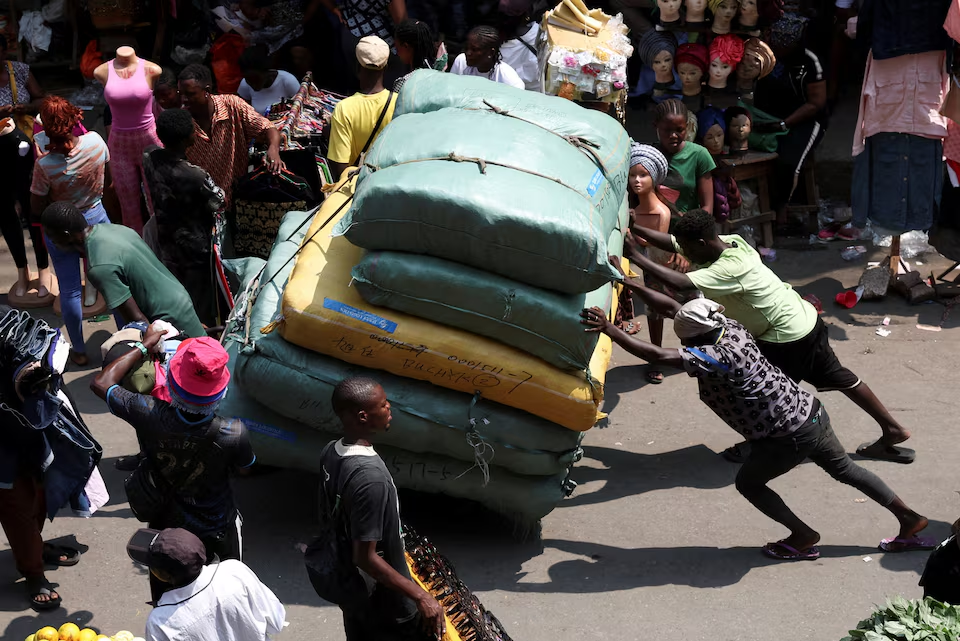

ABUJA, Nigeria — Millions of Nigerians are continuing to struggle with rising living costs as the country moves closer to the 2027 general elections, with households facing higher prices for food, housing, electricity and transportation despite government assurances that economic reforms will eventually deliver broader benefits.
For many workers, the gap between income and everyday expenses has become increasingly difficult to manage.
Grace Adama, a health worker with a non-governmental organisation in Abuja, earns about ₦135,000 a month — almost twice Nigeria’s current minimum wage. Yet she says her income is often exhausted within days of receiving it because of the rising cost of basic necessities.
“If I’m paid today, my salary stays with me just for one week,” Adama said, describing the pressure created by higher rent, electricity bills and food prices.
She said the situation has forced her to reduce household spending and make difficult choices that would have been unnecessary before the current economic crisis.
Adama has cut meat from her diet, moved into a smaller apartment and reduced the amount of financial support she can send to her elderly mother in Benue State. Even after those adjustments, she said she sometimes has to rely on short-term loans to meet her obligations.
The experience reflects a wider cost-of-living crisis that has affected households across Nigeria since President Bola Tinubu assumed office and introduced a series of major economic reforms.
Reforms bring pain to households
The Tinubu administration removed the long-standing petrol subsidy shortly after taking office, while also allowing significant changes in the foreign exchange market that weakened the naira.
Electricity subsidies have also been reduced as the government attempts to lower the financial burden on the state and move the economy towards a more market-driven system.
Government officials and investors have argued that the measures were necessary because Nigeria was facing serious fiscal challenges. They maintain that the reforms are designed to stabilise public finances, attract investment and create conditions for stronger economic growth over time.
For ordinary Nigerians, however, the immediate impact has largely been an increase in the cost of living.
The price of preparing a typical pot of jollof rice has more than doubled since Tinubu came to power, according to an index produced by Lagos-based research firm SBM Intelligence that tracks the cost of ingredients used to prepare the popular Nigerian meal.
Fuel prices have also increased dramatically following the removal of the petrol subsidy. The weaker naira and changes in global oil prices have added further pressure to transportation and household expenses.
For families whose salaries have not increased at the same pace, the result has been a significant decline in purchasing power.
Investors see a different Nigeria
The economic picture looks considerably different from the perspective of financial markets and international investors.
While households continue to complain about high prices and declining disposable income, investors have expressed greater confidence in Nigeria’s economic direction.
Thys Louw, a portfolio manager at investment firm Ninety One, described investor sentiment towards Nigeria as among the strongest seen in roughly two decades.
The argument from investors is that Nigeria is undergoing difficult but necessary reforms that could eventually create a more sustainable economy.
That optimism, however, has created a growing contrast between the performance of financial markets and the experience of ordinary households.
The country is already marked by sharp economic inequalities. Nigeria has major commercial centres such as Lagos, where luxury developments and high-value businesses operate alongside communities where residents struggle to afford basic necessities.
In the northeast, insecurity has added another layer of economic hardship, while millions of Nigerians across the country continue to deal with unemployment, expensive food and inadequate household incomes.
Poverty remains a major concern
The World Bank estimated that slightly more than half of Nigeria’s population lived in poverty in 2025, compared with about 42 per cent in 2022.
The figures highlight the difficulty facing the government as it attempts to persuade citizens that the economic pain associated with its reforms will eventually translate into improved living standards.
The administration has repeatedly defended its policies, arguing that the previous economic model was unsustainable and that reforms were required to restore stability.
But the benefits promised in the long term have yet to become sufficiently visible to many households struggling with today’s expenses.
The rising cost of food remains one of the most immediate concerns.
Families have increasingly adjusted what they buy, how often they eat certain foods and where they live. Some households have also turned to borrowing simply to cover routine expenses before the next salary arrives.
For workers like Adama, economic statistics and investor confidence offer little comfort when monthly income disappears within days.
“I can’t even send money to my aged mother at home,” she said, adding that there are many things she can no longer afford to do.
Economic hardship becomes an election issue
The growing pressure on household finances is expected to become an important political issue as Nigeria approaches the 2027 elections.
President Tinubu and his political allies will need to convince voters that the sacrifices associated with the reforms are producing meaningful improvements and that the benefits will eventually reach ordinary citizens.
The challenge is particularly significant because Nigerians judge economic performance largely through everyday experiences — the price of food in markets, transport fares, electricity bills, rent and the amount of money left after essential expenses have been paid.
The government can point to improvements in some economic indicators and increased investor confidence, but those developments must eventually translate into better living conditions if public support for the reforms is to strengthen.
For opposition politicians, the continuing hardship provides an opportunity to argue that the government’s economic programme has placed too much pressure on citizens without delivering sufficient relief.
The political debate is therefore likely to centre not only on whether the reforms were necessary, but also on how quickly Nigerians can expect to feel their benefits.
A difficult balancing act for Tinubu
The administration faces a delicate task: maintaining reforms that investors regard as necessary while responding to citizens who say the immediate cost has become unbearable.
Reversing the policies could undermine some of the economic gains the government says it has achieved, while allowing living costs to remain elevated could deepen public frustration.
The situation also raises questions about how the government can improve social protection, expand employment opportunities and increase household incomes while maintaining fiscal discipline.
For millions of Nigerians, the ultimate measure of economic recovery will not simply be stronger financial markets or improved investor sentiment.
It will be whether salaries can cover household expenses, whether families can afford nutritious food, whether workers can pay rent and electricity bills without borrowing, and whether parents can continue supporting relatives who depend on them.
As the country moves towards another major election, the economic experience of ordinary Nigerians could become one of the most important factors shaping the political conversation.
The central question facing the Tinubu administration is increasingly clear: can the economic reforms that have won greater confidence from investors also deliver tangible relief to the Nigerians who have endured their immediate costs?
You Might Also Like