China is facing one of the most consequential demographic shifts in modern history, as its population growth slows to a crawl and the country’s once-limitless workforce begins to contract. With births at record lows and deaths rising steadily, Beijing is confronting a future in which fewer workers must support more retirees, threatening economic momentum, social stability, and political legitimacy. While government efforts to reverse the decline through family incentives and social reforms have produced limited results, Chinese policymakers are increasingly leaning on a different solution: large-scale automation powered by robotics, artificial intelligence, and digital transformation.

The demographic challenge confronting China is not sudden, nor is it unexpected. For decades, population experts warned that the country’s aging curve would steepen after years of low fertility. Now those predictions are becoming reality. Official statistics released in late 2025 confirmed that China’s birth rate has fallen to the lowest level since national records began, marking another year in which deaths outnumbered births. The population decline has intensified anxieties about the sustainability of China’s economic model, which for years relied on a vast supply of low-cost labor to fuel manufacturing growth and export dominance.
In response, Beijing has introduced a sweeping range of pronatalist policies aimed at encouraging couples to have more children. These include tax deductions for families, direct cash payments for newborns, childcare subsidies, housing incentives, and relaxed marriage registration requirements. Yet despite these measures, young Chinese adults continue to delay or forgo parenthood, citing rising living costs, job insecurity, long working hours, and changing social values. The gap between policy ambition and social reality has widened, leaving the government searching for alternative strategies.
Automation has emerged as one of the most prominent answers. Over the past decade, China has quietly but aggressively invested in robotics, smart manufacturing, and artificial intelligence. What began as an industrial upgrading effort is now becoming a cornerstone of the country’s response to demographic decline. By replacing or augmenting human labor with machines, Beijing hopes to preserve productivity, sustain growth, and prevent the economic slowdown that often accompanies population aging.
At the center of this transformation is Xi Jinping, who has repeatedly emphasized the importance of technological self-reliance and innovation-driven development. Under his leadership, automation is no longer viewed solely as a tool for efficiency but as a strategic necessity for national survival in an era of demographic headwinds and geopolitical competition.
Demographic Reality and Economic Risk
China’s working-age population has been shrinking for several years, reversing a trend that powered decades of rapid growth. As the number of people aged 15 to 64 declines, the proportion of citizens over 60 continues to rise. According to projections from the United Nations, older adults could account for more than half of China’s population by the end of the century if current fertility trends persist.
This shift poses profound challenges. A smaller workforce means fewer taxpayers, reduced consumer spending, and slower economic expansion. At the same time, an aging population places increasing strain on healthcare systems, pension funds, and social services. Without intervention, analysts warn that the combined pressure could undermine confidence in public institutions and erode the foundations of long-term stability.
Economists stress that the issue is not simply the number of people but the balance between workers and dependents. For decades, China benefited from a “demographic dividend,” in which a large working-age population supported relatively few retirees. That dividend is now disappearing. The question facing policymakers is whether productivity gains from automation can compensate for the loss of labor volume.
Automation as a Strategic Response
Automation offers a potential buffer against demographic decline by enabling fewer workers to produce more output. Robots can operate continuously, reduce error rates, and perform tasks that are physically demanding or dangerous. In sectors such as manufacturing, logistics, and energy, automation can significantly increase efficiency and lower production costs.
China has embraced this approach at an unprecedented scale. It is already the world’s largest market for industrial robots, accounting for more than half of all new installations globally in 2024, according to the International Federation of Robotics. Robotic arms now populate assembly lines across the country, welding car frames, assembling electronics, and packaging consumer goods with speed and precision.
These advances have helped China maintain its competitive edge in global manufacturing despite rising wages and labor shortages. Highly automated factories are now capable of producing electric vehicles, batteries, and solar panels at massive scale, contributing to China’s expanding trade surplus and reinforcing its position as a leader in green technology exports.
The Rise of “Dark Factories”
One of the most striking symbols of China’s automation push is the emergence of so-called “dark factories.” These facilities operate with minimal or no human presence, allowing production to continue around the clock without the need for lighting, climate control, or rest breaks. Sensors, AI systems, and robotic equipment handle tasks once performed by hundreds of workers.
Dark factories illustrate both the promise and the controversy of automation. On one hand, they demonstrate how technology can offset labor shortages and boost productivity. On the other, they raise concerns about job displacement and the future of work for millions of people whose livelihoods depend on traditional manufacturing roles.
Chinese officials argue that automation does not eliminate jobs but transforms them. As repetitive tasks are automated, workers are expected to shift into roles involving machine supervision, maintenance, programming, and quality control. However, this transition requires significant investment in education and training, particularly for older workers and those with limited formal education.
Humanoid Robots and the Next Frontier
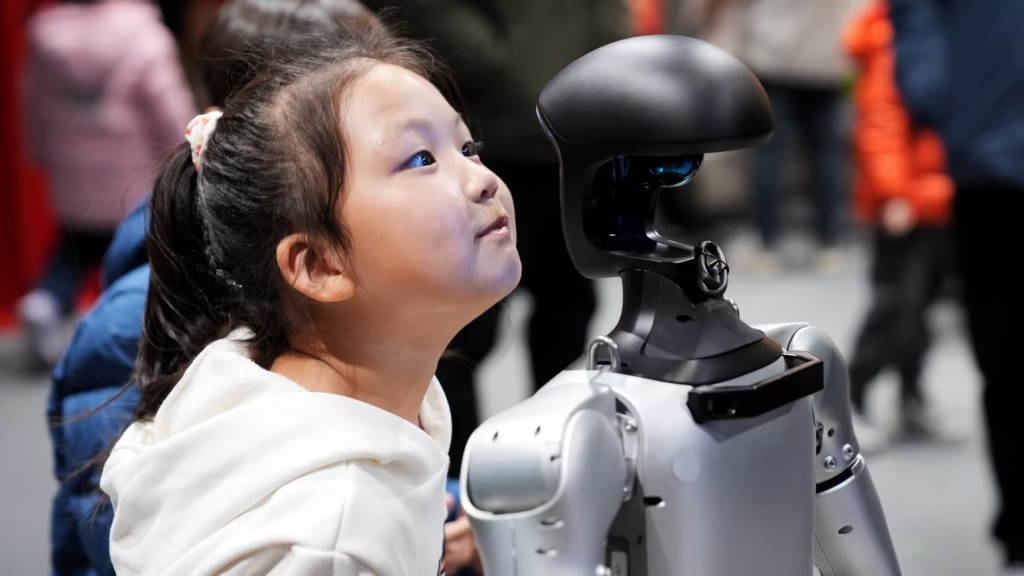
Beyond traditional industrial automation, China is investing heavily in humanoid robots designed to mimic human movement and dexterity. More than 140 companies are now developing humanoid systems, supported by government funding and favorable policies. These robots are being tested in logistics centers, research laboratories, and select manufacturing environments.
While humanoid robots are still in the early stages of development, rapid advances in AI, sensors, and materials science are narrowing the gap between machine and human capability. Developers envision a future in which humanoids can perform tasks such as sorting packages, inspecting products, assisting in warehouses, and even providing basic care services.
State media has frequently showcased humanoid robots dancing, exercising, or participating in promotional events, reflecting both technological ambition and a desire to normalize their presence in everyday life. Officials hope that public familiarity with robots will ease concerns about automation and encourage acceptance of their expanded role in society.
Industrial Policy and Long-Term Vision
China’s automation drive is deeply rooted in its industrial policy framework. The 2015 launch of Made in China 2025 set ambitious targets for upgrading manufacturing capabilities, reducing reliance on foreign technology, and developing domestic champions in high-tech sectors. Robotics, AI, and smart manufacturing were identified as priority areas.
Although demographic decline was not the primary motivation behind this policy, it has since become a key justification for accelerating automation. By embedding robotics into the national development strategy, Beijing aims to ensure that productivity growth continues even as the labor force contracts.
Critics argue that the policy has contributed to trade tensions and accusations of unfair competition. Supporters counter that automation is a necessary adaptation to structural changes in China’s population and economy. Regardless of perspective, the policy underscores the central role technology plays in Beijing’s long-term planning.
Aging Society and Care Automation
The impact of demographic change extends beyond the workplace into daily life. As China’s population ages, demand for elder care services is rising rapidly. The legacy of past population control policies has left many families with a single child responsible for caring for multiple aging relatives, creating emotional and financial strain.
To address this challenge, Chinese authorities are exploring the use of robots and AI in healthcare and elder care. Government guidelines encourage the development of assistive technologies such as robotic caregivers, smart monitoring systems, exoskeletons, and wearable devices that can help older adults maintain independence.
Pilot programs have introduced robots capable of reminding seniors to take medication, monitoring vital signs, and providing basic companionship. While these technologies cannot replace human care entirely, officials see them as a way to supplement limited resources and reduce pressure on families and healthcare workers.
Pension Sustainability and Productivity Growth
China’s pension system is another area under strain from demographic change. As the number of retirees grows and the pool of contributors shrinks, analysts warn that pension funds could face deficits without reform. In response, the government has begun adjusting retirement ages and exploring new funding mechanisms.
Productivity growth is central to this effort. If automation and AI enable each worker to generate more economic value, their contributions to the pension system could support a larger retired population. This concept underpins much of the optimism surrounding technology-driven solutions.
However, experts caution that productivity gains must be broad-based and sustained to have a meaningful impact. Gains concentrated in a few sectors may not be sufficient to offset demographic pressures across the entire economy.
Risks of Displacement and Inequality
Despite its potential benefits, automation carries significant risks. One of the most pressing concerns is job displacement. Estimates suggest that a large share of manufacturing roles could be affected by automation over the coming decades. While some jobs will be transformed or upgraded, others may disappear entirely.
China already faces uneven labor market conditions, with shortages in certain technical fields and high unemployment among young graduates. Rapid automation could exacerbate these imbalances if workers are not equipped with the skills needed for new roles.
To mitigate these risks, officials have announced plans to expand vocational training, reskilling programs, and lifelong learning initiatives. Strengthening social safety nets is also seen as essential to supporting workers during periods of transition.
Social Stability and Political Implications
Economic stability has long been a cornerstone of the Chinese government’s legitimacy. Slowing growth, rising unemployment, or widening inequality could fuel social dissatisfaction. As a result, the automation transition is as much a political challenge as an economic one.
Managing public perception is critical. Authorities emphasize that technology will create new opportunities and improve living standards, rather than simply replacing workers. Success will depend on whether these promises translate into tangible outcomes for ordinary citizens.
Global Implications of China’s Automation Push
China’s approach to automation has implications beyond its borders. As the world’s largest manufacturing economy, changes in China’s production model affect global supply chains, trade balances, and technological competition. Increased automation could reinforce China’s dominance in certain industries while intensifying competition with other manufacturing nations.
At the same time, China’s experience offers lessons for other countries facing demographic decline. Japan, South Korea, and parts of Europe are grappling with similar challenges, and many are watching China’s experiment closely.
A Race Against Time
Experts describe China’s situation as a race between demographic decline and technological progress. If productivity gains from automation outpace the reduction in labor supply, the economy may continue to grow despite population aging. If not, the country could face prolonged stagnation.
Projections suggest that automation could keep China ahead of the curve for several decades. However, uncertainties remain about how quickly technology will advance and how effectively it will be integrated into the broader economy.
Education, Skills, and Human Capital
Investing in human capital is essential to making automation work. Education systems must adapt to emphasize technical skills, creativity, and problem-solving. Workers need opportunities to continuously update their skills as technology evolves.
China has expanded enrollment in technical colleges and universities, but gaps remain in training quality and access. Bridging these gaps will be critical to ensuring that automation benefits are widely shared.
Beyond Technology: A Holistic Approach
Most analysts agree that automation alone cannot solve China’s demographic challenge. It must be part of a broader strategy that includes healthcare reform, pension adjustments, labor market flexibility, and policies that make family life more affordable and attractive.
Encouraging higher fertility remains a goal, even if results have been limited so far. Over time, a combination of social support, workplace reform, and cultural change could stabilize birth rates at a higher level.
The Long View
Demographic change unfolds over decades, not years. This gives China time to adapt, but also demands sustained commitment and careful planning. Short-term gains must be balanced against long-term risks, and technological optimism must be grounded in social reality.
As robots become more visible in factories, hospitals, and homes, the relationship between humans and machines will continue to evolve. Whether this transformation leads to shared prosperity or deepened inequality will depend on policy choices made today.
Conclusion
China’s turn toward robots and automation reflects both necessity and ambition. Faced with a shrinking population and an aging society, Beijing is leveraging technology to preserve growth, maintain competitiveness, and support social systems. The strategy carries promise, but also profound challenges.
If managed effectively, automation could help China navigate its demographic transition and redefine the future of work. If mismanaged, it could amplify economic and social tensions. The outcome will shape not only China’s destiny but also the global economic landscape for generations to come.
You Might Also Like