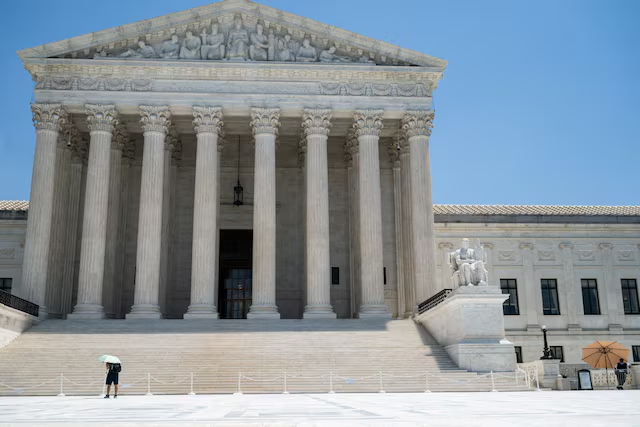
WASHINGTON — A recent U.S. Supreme Court decision removing limits on coordinated campaign spending between candidates and national political parties is expected to significantly reshape the financial landscape of the 2026 Senate elections, potentially weakening one of the Democratic Party’s biggest advantages in several key battleground states.

The ruling allows national party committees to spend unlimited amounts in coordination with candidates, a major shift from previous campaign finance rules that capped such coordinated expenditures.
Political analysts say the decision could particularly benefit Republicans, whose national committees typically attract larger donations from major contributors, helping offset fundraising gaps faced by individual candidates.
Democrats’ cash advantage faces new challenge
The impact of the ruling could be felt in races where Democratic candidates have built substantial financial leads over their Republican opponents.
In Georgia, Democratic Senator Jon Ossoff has emerged as one of the country’s strongest fundraisers, collecting more than $81 million during the current election cycle and maintaining nearly $33 million in campaign cash. His Republican challenger, Representative Mike Collins, trails by roughly $30 million in available campaign funds.
Similar fundraising disparities exist elsewhere, with Democratic candidates reportedly holding cash advantages of about $16 million in North Carolina, $9 million in Ohio and $8 million in Texas.
Under the Supreme Court’s decision, however, national Republican organizations can now direct significantly more coordinated financial support toward candidates who have raised less money individually, reducing the importance of those fundraising gaps.
Court removes spending limits
Before the ruling, federal law placed strict limits on how much political parties could coordinate campaign spending with individual candidates.
Although national party committees were already permitted to spend money supporting candidates, they were restricted in how closely they could coordinate advertising strategies, campaign messaging and voter outreach.
Those coordinated spending limits previously ranged from approximately $130,000 to $4 million, depending on the voting-age population of each state.
The Supreme Court’s decision removes those caps, allowing unlimited coordinated expenditures between campaigns and national party organizations.
Republicans positioned to benefit
Republican campaign committees currently hold considerably more cash than their Democratic counterparts.
According to campaign finance figures, the Republican National Committee (RNC) entered June with substantially stronger finances than the Democratic National Committee (DNC), including a cash advantage estimated at around $110 million, while the Democratic committee is also carrying debt.
Because national committees can receive much larger donations than individual campaigns, the ruling is expected to give Republicans greater flexibility to channel major donor contributions directly into competitive Senate contests.
Political strategists say candidates such as Texas Attorney General Ken Paxton, the Republican Senate nominee, and Georgia’s Mike Collins could now receive significantly more coordinated financial support despite trailing Democratic opponents in direct fundraising.
Battle for Senate control remains competitive
Republicans currently hold a 53-47 majority in the U.S. Senate.
Democrats would need to gain four seats in the November elections to regain control of the chamber.
Several races are expected to determine which party controls the Senate, including contests in Georgia, Michigan, North Carolina, Maine, Ohio, Alaska, Iowa and Texas.
Recent public opinion surveys suggest many of these races remain highly competitive.
Polling released this week indicated Democratic candidates are leading in North Carolina and remain within the margin of error in states including Maine, Texas, Alaska, Iowa and Ohio.
Separate polling in Georgia showed Ossoff holding a double-digit lead over Collins, while Iowa’s Senate race remains closely contested.
Split opinion from the Supreme Court
Writing for the majority, Justice Brett Kavanaugh argued that the decision creates a more level playing field for political parties by removing restrictions on coordinated campaign activity.
In a dissenting opinion, Justice Elena Kagan sharply criticized the ruling, arguing that the court had effectively rewritten campaign finance law established by Congress.
She warned that the decision allows political parties to function as alternative funding accounts for individual campaigns, potentially undermining existing contribution limits.
Advertising rules remain uncertain
Despite the expanded coordination rights, legal uncertainty remains over whether political parties will qualify for the discounted television advertising rates traditionally reserved for candidates.
Republican campaign officials argue the ruling should allow them to purchase campaign advertisements at significantly lower costs while coordinating directly with candidates.
Democratic election lawyers dispute that interpretation, noting that existing Federal Communications Commission rules distinguish between candidate advertising and party advertising, regardless of coordination.
The Federal Communications Commission has not yet clarified how the Supreme Court’s decision will affect advertising regulations.
Both parties expected to adapt
Election law experts say that while Republicans may enjoy an immediate financial advantage because of stronger national fundraising networks, the decision ultimately gives both parties greater freedom to coordinate campaign resources.
Democratic legal representatives acknowledged their disagreement with the ruling but noted that both parties will now be able to provide substantially greater financial and strategic support to their Senate candidates heading into one of the most competitive election cycles in recent years.
You Might Also Like