Missiles Intercepted Over Dubai as Iran Escalates Retaliation in Expanding US-Israel War
Tensions in the Middle East have sharply escalated after missiles were intercepted over Dubai, following fresh threats from Iran to avenge the killing of a top security official in an Israeli airstrike.
Authorities in the United Arab Emirates confirmed that air defence systems successfully shot down an incoming missile, preventing casualties, though residents reported hearing a loud explosion across parts of the city.
Iran Vows “Decisive” Retaliation
The interception came shortly after senior Iranian military officials issued strong warnings of imminent retaliation.
Amir Hatami, a senior Iranian commander, declared that Tehran’s response would be “decisive” following the killing of Ali Larijani, a key figure within Iran’s national security structure.
Larijani, who served as secretary of Iran’s Supreme National Security Council, was killed in a targeted airstrike attributed to Israel, according to Iranian authorities.
His death marks one of the highest-level assassinations since the conflict began, significantly raising the stakes in the ongoing war.
Retaliatory Strikes on Israel
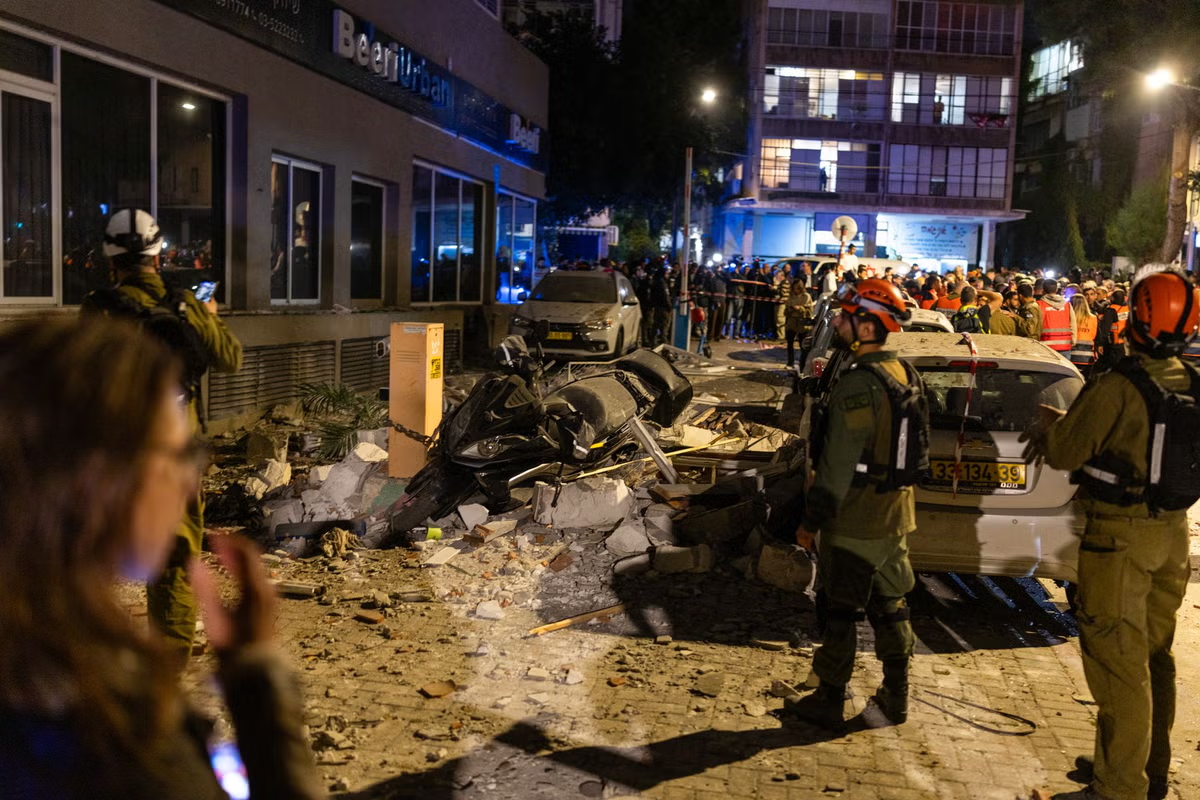
In response, Iran launched missile attacks targeting central areas of Israel, with explosions reported near Tel Aviv.
Emergency officials confirmed that at least two people were killed in the strikes, with additional injuries reported.
Iran’s Islamic Revolutionary Guard Corps said the attacks were carried out in direct retaliation for the killing of Larijani and other officials.
War Expands Beyond Primary Battle Zones
The attempted strike on Dubai signals a widening of the conflict beyond traditional battle zones.
Analysts say the targeting of Gulf cities reflects a broader Iranian strategy to:
Pressure U.S. allies in the region
Disrupt economic and financial hubs
Demonstrate reach beyond its borders
The Gulf region, home to key global energy infrastructure, is now increasingly exposed to the risks of escalation.
Leadership Losses Intensify Conflict
The killing of Ali Larijani is seen as a major blow to Iran’s leadership.
He is among the most senior figures reportedly killed since the assassination of Ali Khamenei at the onset of the war — an event that dramatically reshaped Iran’s political and military command structure.
Such high-profile losses are likely to fuel further retaliation and prolong the conflict.
Trump Criticizes NATO Amid Escalation
Meanwhile, Donald Trump has intensified political rhetoric surrounding the war.
In recent remarks, he criticized NATO, accusing the alliance of failing to support the United States during a critical phase of the conflict.
Trump specifically pointed to disputes over securing the Strait of Hormuz, a vital maritime route for global oil shipments.
Strategic Importance of the Strait of Hormuz
The Strait of Hormuz remains a central flashpoint in the conflict.
Roughly a fifth of the world’s oil supply passes through this narrow channel, making it one of the most strategically important waterways globally.
Any disruption to traffic in the strait could have immediate consequences for:
Global oil prices
Energy supply chains
International shipping routes
Rising Risk of Regional War
The latest developments suggest the conflict is moving toward a broader regional confrontation.
Key indicators include:
Missile strikes reaching Gulf cities
Continued exchanges between Iran and Israel
Growing involvement of U.S. forces
Increased targeting of infrastructure
Security experts warn that further escalation could draw additional countries into the conflict.
Civilian and Economic Impact Growing
Although no casualties were reported in Dubai, the psychological and economic impact is already being felt.
Residents described panic following the explosion, while businesses and aviation authorities are reassessing risk levels.
In Tel Aviv, the human toll continues to rise as missile attacks intensify.
A Conflict Entering a Dangerous Phase
The latest round of attacks underscores how quickly the war is evolving.
With high-ranking officials being targeted, missile strikes expanding geographically, and global powers increasingly involved, the situation is entering what analysts describe as a more unpredictable and dangerous phase.
As Iran, Israel, and the United States continue to exchange strikes, the risk of a wider regional conflict — with global consequences — is growing by the day.
You Might Also Like