US Judge to Consider Fresh Legal Challenge Against Trump’s $400 Million White House Ballroom Project

A federal court in Washington, D.C. is set to revisit a high-stakes legal battle over Donald Trump’s controversial $400 million plan to construct a grand ballroom on the White House grounds.
The case, which has drawn national attention, pits preservation advocates against the federal government over questions of executive authority, historical protection, and the future of one of America’s most iconic landmarks.
Court to Weigh New Injunction Request
At the center of the dispute is Richard Leon, a U.S. District Judge who is scheduled to hear fresh arguments regarding whether construction on the project should be halted.
The hearing will focus on a renewed request for a preliminary injunction filed by the National Trust for Historic Preservation, which is seeking to stop further development while the broader legal case is decided.
A preliminary injunction, if granted, would temporarily block construction activities, potentially delaying or derailing the project.
Controversy Over Demolition of Historic East Wing
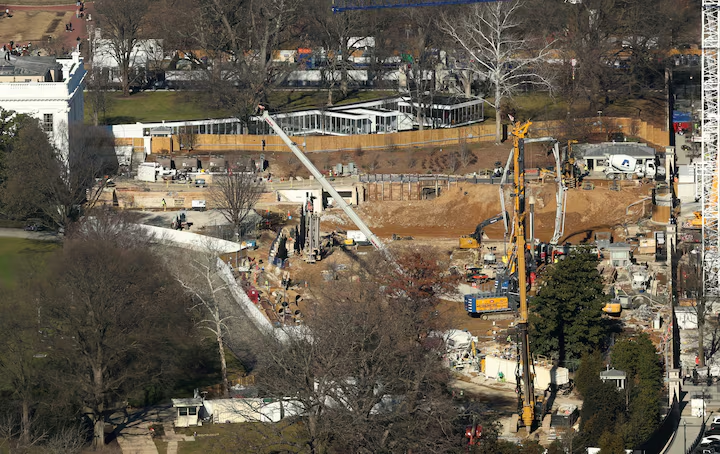
The dispute stems from the demolition of the historic East Wing, a structure that had stood for more than a century before being removed to make way for the new development.
Preservationists argue that the destruction of the East Wing represents a significant loss of cultural and architectural heritage.
They also contend that the replacement structure — a 90,000-square-foot ballroom — is incompatible with the historical character of the White House complex.
Preservationists Challenge Presidential Authority
In its latest legal filing, the National Trust for Historic Preservation argues that the president exceeded his authority by moving forward with the project without explicit approval from Congress.
The group maintains that:
The White House grounds are part of federally protected land
Major structural changes require legislative authorization
The executive branch cannot unilaterally approve large-scale construction projects of this nature
They further argue that historical precedent shows Congress typically plays a direct role in authorizing significant additions to federal properties.
Government Defends the Project
The United States Department of Justice, representing the administration, has pushed back strongly against the claims.
In court filings, government lawyers argued that the plaintiffs have not met the legal threshold required to justify halting the project.
Officials say the ballroom development offers several benefits, including:
Upgraded infrastructure
Enhanced security features
Reduced strain on the historic Executive Mansion
The government also frames the project as a modernization effort that could help preserve the main White House structure by shifting large events to a purpose-built venue.
Earlier Court Decision Rejected Halt
This is not the first time the issue has come before the court.
Judge Richard Leon previously declined to block construction, ruling that the arguments presented at the time did not justify issuing an injunction.
However, the latest filing introduces new legal arguments focused more narrowly on statutory authority and congressional oversight, prompting a fresh review.
Design Approval Raises Questions
The ballroom project has already received approval from the U.S. Commission of Fine Arts, which voted unanimously in favor of the proposal earlier this year.
However, critics have questioned the independence of that decision, noting that all members of the commission were appointed by President Trump shortly before the vote.
This has fueled broader concerns about governance and oversight in the approval process.
Part of a Larger Vision for Washington
The ballroom initiative is just one element of a wider effort by Donald Trump to reshape the visual and cultural landscape of Washington.
Other proposals reportedly include:
A large ceremonial arch rising approximately 250 feet
Renovation and redesign of the John F. Kennedy Center for the Performing Arts
Broader architectural changes aimed at modernizing federal landmarks
Supporters say these projects reflect a bold vision for the capital, while critics argue they risk undermining historical preservation standards.
Legal and Constitutional Questions
At its core, the case raises fundamental legal questions about the limits of presidential authority.
Key issues include:
Whether the executive branch can authorize major construction on federal land without Congress
The role of federal agencies such as the National Park Service in approving such projects
The balance between modernization and preservation of historic sites
Legal experts say the outcome could set an important precedent for future administrations.
What Happens Next?
The upcoming hearing will determine whether construction can continue while the case proceeds through the courts.
If the judge grants the injunction:
Work on the ballroom could be paused indefinitely
The project timeline could face major delays
If the injunction is denied:
Construction is likely to continue without interruption
Legal challenges may shift toward a longer-term court battle
A Landmark Case With National Implications
The dispute over the White House ballroom highlights a broader debate about how the United States manages its historic institutions in a modern era.
For preservation advocates, the case represents a fight to protect national heritage.
For the administration, it is framed as an effort to modernize and improve functionality at the highest level of government.
As the legal battle unfolds in Washington, D.C., the outcome could shape not only the future of the White House, but also how far presidential authority extends in reshaping America’s most iconic landmarks.
You Might Also Like