Uganda’s main opposition party on Friday claimed that security forces forcibly removed opposition leader Bobi Wine from his residence in the capital, Kampala, amid growing tensions following elections expected to hand President Yoweri Museveni another overwhelming victory.

In a statement shared on social media, Wine’s National Unity Platform (NUP) alleged that an army helicopter landed inside his compound and that soldiers took him away to an undisclosed location. The party described the move as an abduction and said Wine’s whereabouts were unknown hours later.
Independent verification of the claim was not immediately possible. Some senior figures within NUP said they were still trying to confirm details. Uganda’s government and military had not responded to requests for comment by the time of filing this report.
The incident comes a day after Wine accused authorities of large-scale electoral fraud and urged supporters to protest the outcome of Thursday’s vote. His party had earlier said he was effectively under house arrest, with security forces blocking access to his home.
Election held under blackout as Museveni extends grip on power
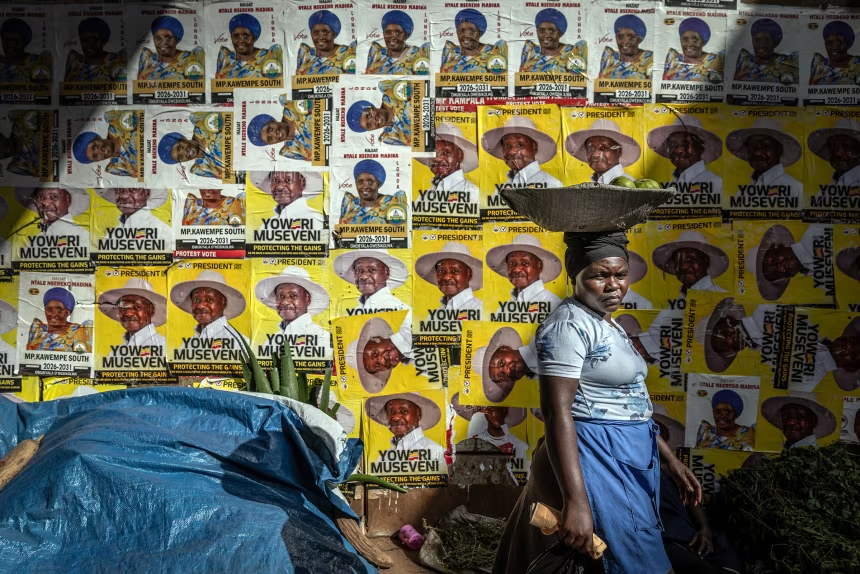
Uganda’s general election has been closely watched both domestically and internationally, seen as a key test of Museveni’s hold on power after nearly four decades in office.
As of Friday evening, provisional results released by the Electoral Commission showed Museveni, 81, securing close to 74% of the vote, while Wine trailed with about 23%. Museveni has ruled Uganda since 1986 and has repeatedly amended laws to remove term and age limits.
The election took place under an internet shutdown, a move criticized by rights groups as an attempt to limit communication, monitoring, and mobilization by opposition supporters.
Wine, a former pop star turned politician, has consistently rejected the results, describing the vote as neither free nor fair. He has pointed to arrests of opposition figures, harassment of supporters, and restrictions on campaigning in the lead-up to the polls.
Overnight violence leaves multiple dead
While voting itself was largely peaceful, violence erupted overnight in Butambala, a town about 55 kilometers southwest of Kampala.
Police spokesperson Lydia Tumushabe told reporters that armed opposition supporters attacked a police station and vote-counting center, prompting security forces to respond.
“Security responded in self-defense,” she said, adding that police opened fire after being confronted by machete-wielding attackers. She confirmed that 25 people were arrested.
However, opposition lawmaker Muwanga Kivumbi, who represents the area, offered a sharply different account.
Kivumbi told reporters that 10 people were killed inside his home around 3 a.m. while they were waiting for parliamentary election results.
“They broke into my house and began shooting,” he said. “People were inside the garage waiting to celebrate my victory. It was a massacre.”
He rejected police claims that the deaths occurred during clashes at a police station and insisted that security forces stormed his residence without provocation.
Police said they were not aware of any killings at Kivumbi’s home and noted that his house is located near the local police station. The exact circumstances surrounding the deaths could not be independently verified.
Growing concern over repression and stability
International observers and the United Nations had earlier warned that the election period was marked by intimidation, arrests, and excessive use of force against opposition figures.
Despite Museveni’s strong lead, analysts say the handling of the opposition and post-election unrest could undermine claims of stability and further strain Uganda’s democratic credentials.
Wine’s reported detention has heightened fears of a broader crackdown as authorities move to consolidate control and prevent protests.
Uganda’s elections have historically been followed by unrest, and the government has often responded with heavy security deployments. With Museveni poised to extend his rule, critics say the country is entering another period of heightened political repression.
As of Friday night, Bobi Wine’s location remained unknown, and his party continued to call for international attention and pressure on the Ugandan government.
You Might Also Like