Syria and Druze Factions Carry Out Prisoner Exchange in Deal Brokered by President’s Brother
Damascus / Sweida — Syrian authorities and a powerful Druze faction in the country’s south have completed a prisoner exchange following months of indirect negotiations, in a deal brokered by the brother of President Ahmad Al Shara, according to sources familiar with the talks.
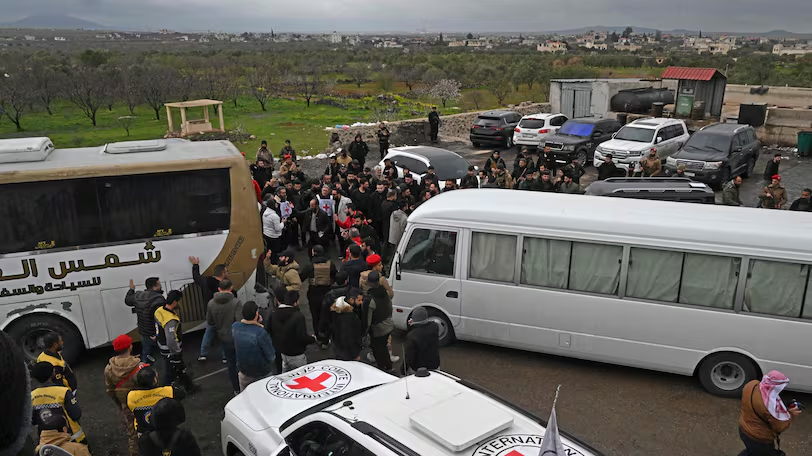
The exchange, overseen by the International Committee of the Red Cross, involved 25 Syrian government personnel and 61 Druze detainees, including children, and took place amid lingering instability in the southern province of Sweida.
While limited in scope, the swap marks a rare confidence-building step between Damascus and Druze leaders after months of deadly clashes and deep mistrust.
Presidential Brother Played Key Role
Sources told DGR News that the deal was personally brokered by Maher Al Shara, the elder brother of the president and Syria’s chief of staff. Though his official role is administrative, Maher Al Shara has emerged as one of the most influential figures in the post-Assad political order, frequently handling sensitive security and foreign policy files.
According to a Druze figure involved in the negotiations, talks between the two sides had been ongoing for nearly two months through Red Cross intermediaries, but stalled until Maher Al Shara met a representative of senior Druze cleric Hikmat Al Hijri in Damascus.
“That meeting focused on confidence-building measures,” the source said. “The prisoner exchange was the first tangible result.”
Maher Al Shara was supported in the negotiations by Hussam Al Tahhan, a government official responsible for security coordination in Sweida. Talks on the Druze side were led by a close associate of Al Hijri.
Exchange Linked to US-Brokered Ceasefire Deal
Syrian officials said the swap forms part of a September ceasefire agreement brokered by the United States to halt fighting between government forces and armed groups in the predominantly Druze region.
Interior Ministry spokesman Nour Al Din Al Baba said the exchange was intended to “ease tensions in Sweida and advance a peaceful political solution.”
“A national solution to the Sweida issue is being pursued with international efforts,” he added.
The September agreement committed both sides to releasing all detainees and abductees taken during the government’s July offensive on Sweida, though Druze sources say the deal remains only partially implemented.
Dozens Still Missing After July Fighting
Despite Thursday’s exchange, the fate of at least 120 people — from both sides — who disappeared during the July clashes remains unresolved, according to local leaders.
The fighting erupted after months of resistance by Druze authorities to Damascus’s attempts to reassert control over Sweida, appoint new officials, and dismantle local armed groups. Government forces, backed by tribal auxiliaries, launched an offensive that killed hundreds of civilians, most of them Druze, and displaced thousands.
The operation triggered Israeli military strikes against Syrian government targets, marking one of the most serious escalations involving Israel since the political transition in Damascus.
How the Exchange Took Place
Syrian state television reported that Druze detainees were transported by bus from a prison in Damascus to a government checkpoint near Sweida, where the exchange was carried out.
They were swapped for 25 security personnel held by a militia known as the National Guard, and transferred to a compound inside Sweida city, where family members were waiting.
“The switch has occurred,” said independent activist Rayyan Maarouf, confirming the completion of the deal.
Druze sources said several of those released were minors, while the Interior Ministry described conditions endured by detainees held by armed groups as “extremely dire.”
A Deeply Unresolved Sectarian Question
The Druze issue remains one of Syria’s most complex sectarian challenges. The religious minority — spread across Syria, Lebanon, Jordan, and Israel — has historically guarded its autonomy.
Al Hijri has accused the Damascus government of extremism and called for a form of self-determination for Syria’s Druze — a position firmly rejected by President Al Shara, who insists on a unitary state.
Since toppling former president Bashar Al Assad in December 2024, Al Shara — once linked to Al Qaeda — has repositioned himself as a pragmatic leader open to engagement with Washington and even potential peace with Israel.
However, the unresolved conflict in Sweida continues to undermine those efforts.
Humanitarian Crisis Continues
Government forces have effectively encircled Sweida since the summer fighting, leaving much of the population dependent on UN and Red Cross aid convoys. Sporadic violence, shortages of fuel and medicine, and political deadlock persist.
While Thursday’s prisoner exchange is being welcomed as a rare breakthrough, analysts and local leaders warn it represents only a small step toward resolving a conflict that remains deeply rooted in mistrust, sectarian fears, and competing visions for Syria’s future.


