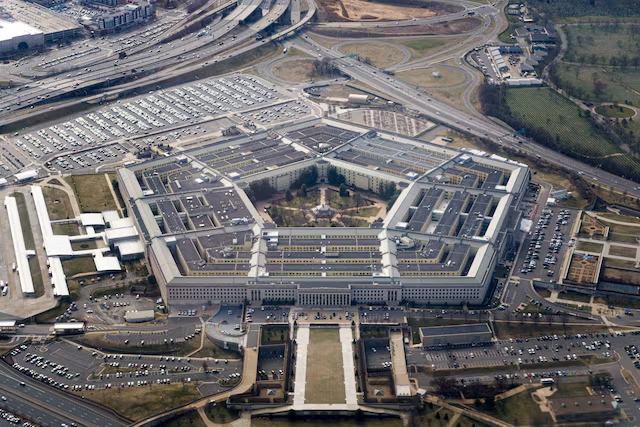
Pentagon Briefings Cast Doubt on Claim of Imminent Iranian Attack on U.S. Forces
Senior U.S. defence officials have privately acknowledged to lawmakers that intelligence agencies did not detect plans by Iran to strike American forces before the United States and Israel launched large-scale military operations against Tehran, according to sources familiar with classified congressional briefings.
The disclosure, made during extended closed-door sessions on Capitol Hill, complicates the public justification offered by the administration of Donald Trump, which framed the offensive as a necessary step to pre-empt potential Iranian attacks on U.S. personnel in the Middle East.
Intelligence vs Public Rationale
Officials from the Pentagon briefed Democratic and Republican staff from multiple national security committees in the United States Congress for more than 90 minutes, outlining the scope and objectives of the campaign.
According to two people familiar with the discussions, briefers emphasized that Iran maintains significant missile capabilities and regional proxy forces that pose a long-term threat to U.S. interests. However, they acknowledged there was no specific intelligence indicating Tehran was preparing to launch a first strike against American forces at the time the operation began.
That admission contrasts with statements made publicly by senior administration officials a day earlier, suggesting the president acted on indicators that Iran might move “pre-emptively” against U.S. troops. The administration argued it could not risk American forces absorbing an initial blow.
Scope of the Military Operation
The United States and Israel began their most extensive coordinated assault on Iran in decades on Saturday, targeting military infrastructure, naval assets and missile facilities. Officials say more than 1,000 sites have been hit so far.
Iran’s leadership suffered a dramatic blow with the killing of Supreme Leader Ali Khamenei, a development that has sharply escalated regional tensions and raised questions about Iran’s internal stability.
President Trump has said the campaign, expected to continue for weeks, is aimed at preventing Iran from obtaining nuclear weapons, curbing its ballistic missile program and neutralizing threats to the United States and its allies. He has also publicly encouraged Iranians to challenge the current government.
Political Backlash at Home
Democratic lawmakers have sharply criticised the operation, describing it as a “war of choice” and questioning the decision to abandon diplomatic channels. Mediators in Oman had indicated that negotiations with Iran still showed signs of progress before the strikes began.
Trump has claimed Iran was nearing the capability to strike the United States with a ballistic missile, but sources familiar with U.S. intelligence assessments say that assertion was not supported by available reports and appears overstated.
The gap between classified intelligence and public messaging has intensified scrutiny on the administration’s legal and strategic rationale for launching major combat operations without clear evidence of an imminent attack.
U.S. Casualties and Military Details
As the conflict enters its early phase, the U.S. military has confirmed its first casualties. U.S. Central Command said three American troops were killed and five seriously wounded, with additional personnel suffering minor injuries from shrapnel and concussions.
U.S. forces have employed a wide array of assets, including B-2 stealth bombers deploying 2,000-pound bunker-busting munitions against fortified underground missile sites. Warships and aircraft have also targeted Iranian naval and air defence positions.
Public Opinion Remains Divided
Domestic support for the campaign appears limited. A poll conducted by Ipsos for DGR News found that just over a quarter of Americans approve of the strikes, while a larger share oppose them and a significant portion remain undecided.
Broader Implications
The acknowledgment that Iran was not poised to strike first raises difficult questions about pre-emptive warfare, intelligence interpretation and executive decision-making. As the military campaign expands, the administration is likely to face growing pressure from lawmakers to reconcile its public arguments with the assessments shared behind closed doors — and to clarify the endgame of a conflict that risks reshaping security dynamics across the Middle East.