Israeli Airstrikes Kill 31 Dozens in Beirut After Hezbollah Attack, Deepening Regional Conflict
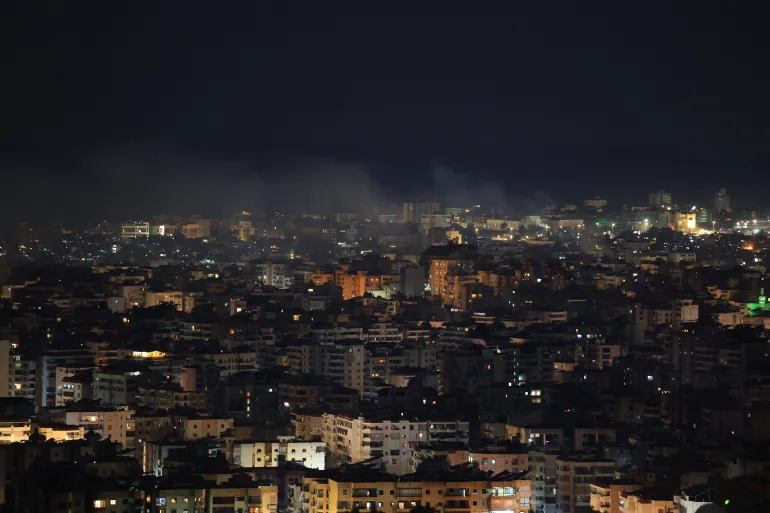
Beirut / Tel Aviv — Israeli warplanes struck multiple targets in and around Beirut on Monday, killing at least 31 people and injuring nearly 150 others, after the Lebanese militant group Hezbollah launched a rocket and drone attack against the northern Israeli city of Haifa. The swift and lethal exchange marks a significant escalation between the long-entrenched adversaries and raises fears of a wider, region-wide conflict.
Lebanese state media, including the National News Agency, reported that civilian areas in Beirut were among those hit during Israeli airstrikes. Local health officials said at least 31 people were killed and 149 wounded — figures that underscore the toll on non-combatants in a city long accustomed to periodic flare-ups of violence.
Hezbollah Attack Cited as Retaliation
Hezbollah claimed responsibility for the initial strike, saying its forces targeted an Israeli military installation in Haifa with rockets and unmanned aerial vehicles. In its statement, the group framed the attack as retaliation for the killing of Ali Khamenei, Iran’s supreme leader, and as a defence of Lebanese sovereignty against what it characterised as repeated Israeli aggression.
“The resistance leadership has always affirmed that the continuation of Israeli aggression and the assassination of our leaders, youth and people gives us the right to defend ourselves and respond at the appropriate time and place,” Hezbollah said, reiterating its long-standing position that Israeli attacks on southern Lebanon and other areas justify armed resistance.
Hezbollah’s statement also accused Israel of a 15-month campaign of “aggression,” a reference to near-daily strikes that Lebanese officials have documented across the country. Until now, Hezbollah had largely restrained its response, urging the Lebanese government to shoulder diplomatic efforts instead of returning fire.
Israeli Response and Military Statements
Israel’s Defence Minister Israel Katz responded with sharply worded threats. He vowed that Hezbollah would pay a “heavy price” for its attack and specifically named Hezbollah’s deputy leader Naim Qassem as “a marked target for assassination.” Katz’s comments signalled a willingness to target senior militant leaders, raising the spectre of retaliatory strikes on political as well as military figures.
The Israel Defense Forces said it was conducting operations throughout Lebanon “to act against Hezbollah’s decision to join the campaign,” asserting that it would not allow the group to pose threats to Israeli towns near the border. It also emphasised that Hezbollah’s activities were destabilising Lebanon itself.
Evacuations and Civilian Displacement
In a significant move, Israeli authorities ordered residents in more than 50 villages and towns in southern Lebanon and the Bekaa Valley, including Bint Jbeil, to evacuate their homes and stay clear of key infrastructure. The warnings, urging civilians to keep at least 1 kilometre away from buildings, echo the large-scale displacement orders Israel issued during its devastating campaign in Gaza.
The broad evacuation calls could trigger another humanitarian crisis in a country already struggling with economic collapse, political dysfunction and years of displacement from earlier conflicts.
Political and Humanitarian Fallout
Lebanon’s Prime Minister Nawaf Salam condemned Hezbollah’s actions as “irresponsible and suspicious,” warning that they jeopardise both national security and the welfare of ordinary Lebanese people. In a message on social media platform X, Salam said the government would work to protect citizens and hold those responsible to account, signalling political divisions within Lebanon over Hezbollah’s role.
Lebanese authorities had previously attempted to assert greater control over armed groups, including a 2025 decree aimed at disarming Hezbollah. The militant organisation rejected the decree, arguing that its weapons were essential to defend Lebanon against Israeli expansion and incursions.
The civilian toll has reignited criticism of both sides. Human rights groups, already alarmed by repeated strikes on Lebanese infrastructure, argue that the protection of civilians is being neglected in the escalation. Hospitals have reported surges in casualties, and emergency services are strained.
Erosion of Previous Truce
The current confrontation represents a breakdown from a ceasefire arrangement reached in 2024. While that truce greatly reduced large-scale hostilities, Israel has carried out frequent strikes inside Lebanon — actions the Lebanese state repeatedly decried as violations of its sovereignty. In January, Beirut lodged a formal complaint with the United Nations, documenting more than 2,000 alleged violations by Israeli forces over a three-month span in late 2025.
Hezbollah had largely refrained from escalating in response, arguing that Lebanon’s government should take the lead, but Monday’s offensive signalled a decisive shift back to open confrontation.
Broader Regional Implications
Analysts see the violence as part of a widening regional confrontation that now encompasses not only Israel and Hezbollah, but also Iran and its network of allied militias. The killing of Iran’s supreme leader was itself a dramatic escalation, and Hezbollah’s intervention suggests Tehran’s broader axis of allies may be more prepared to respond directly.
Whether the conflict will widen further remains uncertain. Hezbollah’s military capacity was significantly degraded in earlier clashes with Israel, and it is unclear how much damage it can now inflict at scale. Nevertheless, its ability to strike deep into Israeli territory and prompt such a forceful response underscores the risks of a larger conflagration.
For now, residents of Lebanon face renewed fear and disruption, while diplomatic channels remain strained and prospects for de-escalation appear distant. Both governments are likely to emphasise security narratives at home, but the growing civilian cost could increase pressure on regional and international actors to urgently intervene or mediate before the conflict expands further.
This is really heartbreaking
The conflict just keeps escalating. When will it end?
Innocent lives are always the ones that suffer.
Prayers for the people of Beirut.