GAZA — The United Nations has warned that the removal of rubble from Gaza could destroy evidence needed to investigate alleged war crimes, raising concerns over the handling of sites where people were killed and human remains may still be buried.
Francesca Albanese, the UN Special Rapporteur on the occupied Palestinian territory, said on Monday that states and companies involved in clearing the debris could potentially face international criminal responsibility if their actions result in the destruction of evidence of alleged crimes.
Her warning comes against the backdrop of a 2024 order by the International Court of Justice (ICJ) requiring Israel to take effective measures to prevent the destruction of evidence related to allegations brought under the Genocide Convention.
“It is unacceptable that the reconstruction of Gaza is conditioned upon the erasure of its past and the evidence required to secure justice for its victims,” Albanese said.
The warning has heightened concerns over the balance between clearing Gaza’s vast destruction and preserving locations that could contain evidence relevant to future investigations.
Millions of Tonnes of Rubble Being Removed
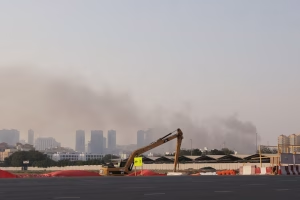
The Israeli military carried out a large-scale rubble clearance operation in August, crushing, mixing and transporting millions of tonnes of debris from numerous locations across Gaza.
The areas involved included cemeteries and other sites where human remains are known or believed to be located, according to Al Jazeera report.
The scale of destruction has left thousands of people unaccounted for beneath collapsed buildings. Palestinian authorities estimate that more than 8,000 people remain buried under rubble, while families continue searching for the remains of relatives killed during the conflict.
Access to the equipment required for those searches remains a major obstacle. Israel continues to prevent heavy machinery and forensic supplies from entering Gaza, according to Al Jazeera report.
The combination of extensive debris removal and limited access to recovery equipment has intensified concerns about whether remains can be recovered before rubble is transported or otherwise altered.
Rights Group Raises Demographic Concerns
The Euro-Med Human Rights Monitor, in a report published last month, also raised concerns about the removal of debris.
The organisation said the clearance could potentially form part of what it described as demographic engineering while also contributing to the removal or destruction of evidence connected to alleged genocide.
Albanese’s intervention focused specifically on the potential legal consequences of destroying evidence. She warned that those participating in rubble removal should consider their responsibilities under international criminal law, particularly where debris may contain evidence relevant to alleged crimes.
The issue is particularly significant because the ICJ’s 2024 order specifically addressed the preservation of evidence relating to allegations under the Genocide Convention.
Families Still Searching for Remains
The urgency of recovering bodies was underscored on Sunday, when Palestinians in northern Gaza held funeral ceremonies for about 100 people whose remains had been retrieved from the rubble of destroyed buildings in Gaza City.
The group included around 60 children.
The recovery of those remains offered families an opportunity to bury relatives whose bodies had remained beneath destroyed structures, but thousands of others are still believed to be trapped under debris across the enclave.
Raed al-Dahshan, head of Gaza’s civil defence service, said the time required to recover the remaining bodies depends heavily on access to appropriate equipment.
He told Al Jazeera that the recovery operation could be completed in roughly 90 days if the necessary equipment were available. Without it, he said, the process could take years.
The dispute over rubble removal therefore extends beyond reconstruction. For families searching for missing relatives, the debris contains the remains of loved ones; for investigators, some of the same sites may contain evidence relevant to allegations arising from the conflict.
Albanese’s warning places the preservation of that evidence within an international legal framework, cautioning that reconstruction efforts should not result in the destruction of material that may be needed to establish accountability for alleged crimes.
UN Warns Gaza Rubble Clearance Could Destroy Evidence Needed for War Crimes Investigations
![Civil defence personnel look for human remains in the central Gaza Strip [File: AFP] Al Jazeera](https://i0.wp.com/dgrnews.com.ng/wp-content/uploads/2026/09/1788832141995.jpg?fit=720%2C480&ssl=1)
Civil defence personnel look for human remains in the central Gaza Strip [File: AFP] Al Jazeera