Gulf Economies Face Widespread Disruption After Iranian Strikes
March 1 | Regional Economic Analysis
Businesses across the Gulf are confronting significant operational and financial disruption after Iran launched coordinated strikes across multiple states in response to a joint U.S.–Israeli military operation. The attacks, which affected airports, ports, residential zones and commercial infrastructure, mark one of the most serious shocks to the region’s economic stability since the COVID-19 pandemic.
Strategic Infrastructure Hit Across the UAE
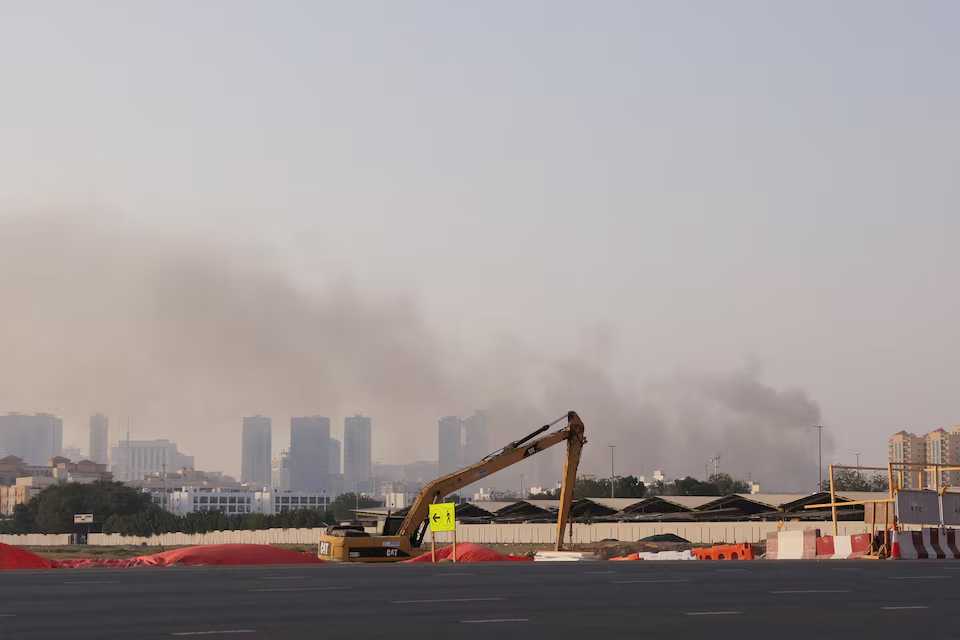
In the Dubai and other parts of the United Arab Emirates, airspace closures and damage to transport facilities triggered immediate business paralysis. Operations at Dubai International Airport and Zayed International Airport were disrupted following reported impacts and aerial interceptions nearby. Authorities confirmed casualties and infrastructure damage.
At Jebel Ali Port, one of the world’s largest container hubs, a berth caught fire, compounding delays in shipping and regional trade flows. Given the Gulf’s role as a global transit corridor linking Asia, Europe and Africa, interruptions at these hubs immediately reverberated across supply chains.
The strikes represent an unusual escalation for Dubai, long positioned as politically insulated from regional conflicts and marketed as a secure commercial gateway for global investors.
Financial Markets React to Escalation
Regional equity markets responded sharply when trading opened. In Saudi Arabia, the benchmark index initially dropped more than 4% before trimming losses. Exchanges in Oman and Egypt also closed lower, while Kuwait suspended trading altogether — an uncommon measure reflecting investor anxiety.
Market analysts suggest volatility will persist as long as military operations continue. International institutional investors typically react first during geopolitical shocks, pulling capital from perceived risk zones. Domestic investors often attempt to stabilize markets by accumulating shares in blue-chip companies, but sustained instability can erode that buffer.
Higher oil prices provide some fiscal cushioning for hydrocarbon exporters such as Saudi Arabia and Qatar, boosting government revenues. However, energy gains do not fully offset disruptions in aviation, tourism, logistics and real estate — sectors that underpin diversification strategies across the Gulf.
Corporate and Tourism Impact
The UAE hosts major regional corporations, including developer Emaar Properties and retail conglomerate Majid Al Futtaim. It has also become a base for global asset managers seeking access to sovereign wealth funds such as the Abu Dhabi Investment Authority and Mubadala Investment Company.
Damage to high-profile hospitality assets highlights risks to the tourism sector. The Fairmont The Palm sustained major fire damage after being struck, while structural harm was reported at the Burj Al Arab. The Fairmont property had recently been acquired by Arzan Investment Management, underscoring the exposure of cross-border Gulf capital to regional instability.
Tourism has been central to Dubai’s economic model since the 1990s pivot away from oil dependence. Any prolonged perception of insecurity could affect hotel occupancy, aviation volumes and property transactions.
Airspace Closures and Travel Advisories
The strikes forced temporary closures or restrictions at major transit airports across the region, including Doha in Doha, disrupting one of the busiest aviation corridors globally.
The United States, United Kingdom, and the European Union updated travel advisories, urging caution and limiting non-essential travel. Such warnings could dampen business travel and conference activity, key revenue streams for Gulf service economies.
Ramadan Business Cycle Interrupted
The timing of the attacks adds another layer of economic consequence. The escalation occurred during Ramadan, a period when corporate iftar and suhoor gatherings play an important role in deal-making and relationship building.
Several organizations — including airline Emirates, renewable energy firm Masdar, education group GEMS Education, and the Department of Government Enablement — postponed or cancelled events. In Gulf business culture, where personal networks significantly influence contracts and investment flows, these cancellations represent indirect economic costs.
Broader Strategic Implications
The Gulf’s long-standing economic strategy has centered on stability, open markets and geopolitical neutrality. Sustained military escalation challenges that positioning. Investors may reassess regional risk premiums, insurers could raise shipping and aviation coverage costs, and multinational firms may delay expansion plans.
While oil exporters benefit from higher crude prices in the short term, diversification sectors — finance, logistics, tourism, technology and real estate — remain more sensitive to instability. The longer the conflict environment persists, the greater the pressure on fiscal planning, sovereign wealth allocations and private-sector confidence.
Governments across the region have introduced remote-work advisories and temporary safety measures to limit public exposure while maintaining essential services. However, economic recovery will largely depend on whether tensions de-escalate quickly or settle into a prolonged cycle of retaliation.
For now, Gulf markets remain in a defensive posture, balancing oil-driven revenue gains against the strategic risk of becoming a direct theater in a broader regional confrontation.