ISIS Escalates Daily Attacks in North-Eastern Syria as Fears of Security Vacuum Deepen
Raqqa / Deir Ezzor — ISIS has launched a sustained wave of near-daily attacks against Syrian government forces in north-eastern Syria, killing at least 13 people in less than a week and raising alarm over a growing security vacuum in areas once central to the fight against the armed group.
According to the Syrian Observatory for Human Rights, at least 10 separate attacks have been carried out over the past four days, leaving 10 Syrian soldiers and security personnel dead, alongside one civilian and two ISIS fighters involved in the assaults.
The escalation follows ISIS’s formal declaration of war against Syria’s post-Assad leadership, issued in an audio message released on February 21. The statement, attributed to Abu Hudhayfah Al Ansari, rejected the legitimacy of Syria’s new government and vowed renewed armed confrontation.
Raqqa hit by coordinated attacks
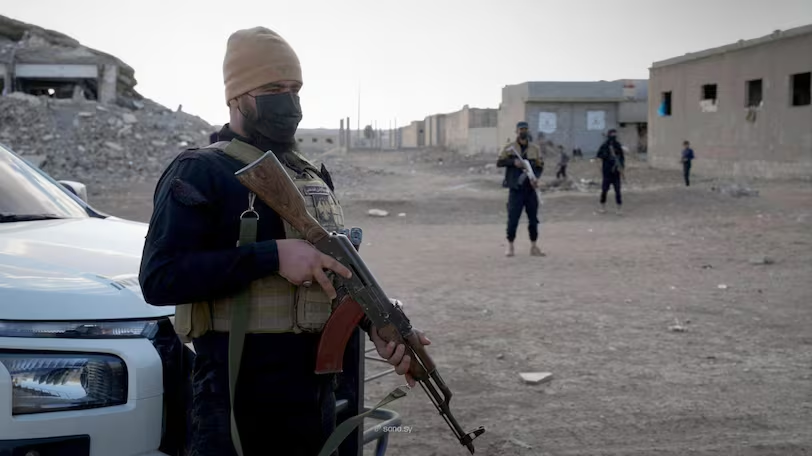
ISIS has claimed responsibility for several of the attacks, including a strike on a security checkpoint in Raqqa on Tuesday night. The attack came just one day after a separate assault inside the city killed four members of Syria’s internal security forces.
Syria’s Interior Ministry said it had dismantled the ISIS cell responsible for both operations following intelligence-led raids.
“Based on accurate intelligence information and investigations, our security units carried out a series of qualitative and simultaneous security operations at dawn today,” said Colonel Rami Asaa Al Taha, commander of internal security in Raqqa governorate, in a statement released Tuesday night.
He said the operations resulted in the killing of one ISIS member and the arrest of four others, adding that security forces would intensify patrols and preventive measures to deter further attacks.
Violence spreads to Deir Ezzor
Beyond Raqqa, multiple attacks were reported in Deir Ezzor, where unidentified gunmen targeted army and security installations across the north-eastern region. While it remains unclear whether all attackers were directly linked to ISIS, the group has long operated in the desert areas surrounding Deir Ezzor and frequently exploits gaps in security control.
ISIS denounces Syria’s new leadership
In its February 21 declaration, ISIS accused Syria’s transitional government of being illegitimate due to its ties with Turkey and the United States. The group described President Ahmad Al Shara as a “new despot” leading what it called a “crusader government,” warning that his fate would mirror that of former ruler Bashar Al Assad.
The rhetoric signals ISIS’s attempt to reassert itself as a destabilising force following years of territorial defeat.
Security vacuum after US drawdown and SDF collapse
The surge in attacks has intensified concerns that ISIS is exploiting a rapidly shifting security landscape. The United States has sharply reduced its troop presence in Syria ahead of a planned full withdrawal, ending a deployment that began more than a decade ago as part of the campaign against ISIS.
At the same time, the Kurdish-led Syrian Democratic Forces — Washington’s main partner in the fight against ISIS — has effectively dissolved after suffering a major defeat by Syrian government forces earlier this year.
Syrian authorities have accused the SDF of enabling a mass escape of detainees linked to ISIS from Al Hol camp, a notorious desert detention facility that has since been closed.
“We were surprised by an uncoordinated withdrawal of the Syrian Democratic Forces more than six hours before the arrival of the Syrian Arab Army,” Interior Ministry spokesman Noureddine Al Baba said at a press conference on Wednesday. “Upon arrival, we observed cases of mass escape resulting from the opening of internal berms and checkpoints of the camp.”
The SDF has denied responsibility, saying its forces were compelled to withdraw in January to defend other cities during a Syrian government offensive.
International concern over detainee escapes
An internal European Union memo seen by Reuters this week warned that thousands of detainees may have escaped from Al Hol, creating fresh opportunities for radical groups to recruit and reorganise.
“This raises concerns about how terrorist groups might seek to capitalise on the current situation to increase recruitment efforts among escapees,” the memo said.
A fragile transition
Syria’s new transitional government formally joined the US-led anti-ISIS coalition in November 2025, marking a dramatic shift after years of isolation. President Al Shara, a former Al Qaeda member who later broke with ISIS, previously led Hayat Tahrir Al Sham, which spearheaded the 11-day offensive that toppled the Assad regime in December 2024.
Despite renewed counter-terrorism operations, analysts warn that ISIS’s ability to carry out frequent attacks highlights the risks facing Syria as it navigates political transition, weakened security structures, and declining international military support.
For now, the group appears determined to exploit instability — testing whether the new order can prevent Syria from sliding back into prolonged insurgency.


